| 
A Few Words About Northern Pike
The small to medium size Northern Pike that have become over-abundant in Northern Minnesota are the perfect target for folks who want to have a lot of action and really enjoy eating fish. Our Department of Natural Resources reports that these smaller fish are so abundant, that it's hard to imagine how fishing pressure could ever reduce the population significantly. Bring the kids and learn how to use some these great eating fish. Yes, you'll have to learn "How To Remove the Y- bones", but it's easy to do and the more practice you get, the better you'll like 'em.
Don't be fooled by some of the folks that don't want to fool around with Northern Pike! Lots of us know how many mouth watering ways there are to prepare these scrappy fish. In fact, there are times when the Northern Pike is the best possible choice for recipes that just wouldn't work for some of our other fish. There are a few key things to remember when you're planning to fix a meal using the Northern Pike. Clean and bone the fish while it is still fresh. The quality of the fillets depends on preventing them from deteriorating. Don't let your fish sit in the live well or ice chest any longer than necessary. When you get off the lake, clean the fish right away. Use Pike when they are fresh. Northern Pike don't remain fresh while frozen as well some of the other popular eating fish. We try to keep only enough for our next meal and plan to use them in a day or two. If we find that freezing some of the fish becomes necessary, we always try to freeze them in a zip-lock plastic bag with water. Even then, try to use the Pike as soon as possible.
Here are some of my favorite ways to prepare Northern Pike for the table. Each one of these recipes has been "Guide Proven" on fishing trips with my customers and have the official "Early Bird" seal of approval! |
Northern Pike: Removing the Y-Bones Easy and Clean! |
 |
This 24 inch Pike (left) is perfect for most of the recipes we
use. You can use larger Pike if you want, but we really encourage releasing
the larger fish and utilizing some of these over-abundant smaller fish. |
| Right: Begin by filleting the fish and removing
the rib bones as you would with Walleye or other freshwater fish. There's no
difference in cleaning these fish up to this point. Once you have taken the
fillet, notice the line of light bones visible between the center line and
the top (fishes back) of the fillet. We call these Y-Bones, but there is
really no "Y". The shape is more like the letter "L". |
 |
Left: These are the fillets before removing
the Y-Bones. The basic fillet process is the same for most of the fish we catch in Northern Minnesota. To learn more about filleting fish click here. |
 |
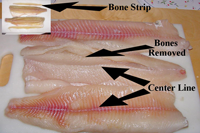
Left: These are the fillets with all of the Y-Bones
removed. Notice the small notches in the Pike fillets. This is all there is
to it. With a little practice, these bones can be removed in just a few
seconds. Pickled fish lovers can save the strips and use them for the
pickled fish recipe included in this section.
To begin removing the Y-Bone, use the tip
of your knife to make a cut just above the top of this line of bones. The
tip of your knife will begin touching the bones where they turn in the
direction of the fishes back. Don't cut through them! Your second cut should
follow this line of bones as they turn toward the top of the fillet. Now you
will see the entire row of bones exposed from one side. Your third and final
cut is to slip the knife under this row of bones and simply follow the same
angle as cut 2, cutting the bones out from the opposite side. |
The finished fillets are cut into thirds. This
is the perfect size for most of the recipes we use at home.
Note: I've updated some of this information. Click here to see an improved version and watch for additional updates as soon as the
fishing season opens and I can legally obtain a Pike for new photos. |
 |
Minnesota Cajun Pike Recipe - From the Early Bird Guide, Jeff Sundin
Catching Northern Pike in the Grand Rapids area has new meaning for folks who have tried my "semi blackened Pike". Sometimes I refer to this jokingly as "Norwegian Style Cajun" because we prepare it using only a light coat of seasoning. Once you try this, you'll be back for more and I guarantee this will be a hit with your friends and family.
*We strongly recommend preparing this dish outside using a propane cooker. |
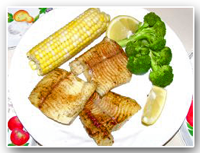
A delicious and healthful way to prepare Pike of 2 to 3 pounds in size. The ingredients are simple and the finished product is light and mouth watering. This is the "tenderloin" of freshwater fish dishes.
Ingredients: Pike fillets boned and cut into thirds, Olive Oil, Louisiana Cajun Spice Mix (or substitute your favorite spice mix). If you don't care for the spicy version. Just use a little lemon pepper and a dash of salt. |
 |
 |
1) Prepare the fillets by cutting them into thirds and coating them with Olive oil. Use only enough olive oil to lightly coat each fillet to prevent sticking in the hot pan. You do not need any only in the pan!
2) Lightly sprinkle each fillet with spice mix prior to placing in the frying pan.
3) Pre-heat a cast iron (best), steel or other non-teflon-coated frying pan under high heat without oil. You'll know it's ready when you begin to see smoke coming from the dry pan. Sear the Northern Pike fillets for a few minutes on each side until fish is cooked, but do not over-cook fish until it dries out. Fillets should be served juicy and hot!
This simple, healthful and delicious dish can be prepared in just a few minutes and it only takes a couple of these small Pike make a great meal for my family of four. |
 |
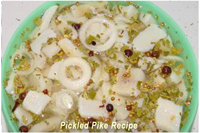
Pickled Northern: The old stand-by for all of us who love pickled fish. If you
are a pickled fish fan, Northern Pike is the perfect fish to use for
pickling. Finished pieces are firm and sweet. Great for parties and makes a
great snack too. |
Starting Brine Phase 1: 1 Cup Salt per Each 1 Quart Water.
Fish pieces soak for 2
Days Exactly.
Vinegar Brine Phase 2: Drain starting brine - Do not rinse
fish pieces. Soak in White Vinegar,
completely covered for 24 hours. After 24 hours, Drain Vinegar-Do not rinse fish
pieces. |
 |
Left: Northern Pike Fillets cut into
pieces about 1 inch square. Use a large plastic bowl and cover with enough
liquid to completely immerse all of the pieces.
Right: Final solution, use a large pickling jar or plastic container like
this Tupperware bowl, be sure pieces are packed loosely and completely
covered with liquid. During the final stage, the fish is ready to eat after
about 5 days. But the finished product will last in the refrigerator for
several months. |
 |
Finishing Brine Phase 3: Mix 4 Cups White Vinegar, 3 Cups Sugar Heat to dissolve Sugar - Let stand
until cool Add 1 Cup White Wine (Silver Satin preferred but other "sweet"
white wines will work) 1/4 Cup mixed
pickling spice Let mixture cool thoroughly before adding to fish. Layer fish pieces and sliced onions in jar and cover with
pickling solution recipe leave covered with pickling solution and let soak for 1
week before eating. Fish will last for several months in refrigerator. |
| Smoking Fish - Basic Salt Brine Recipe |
Basic Brine Mixture |
To Use As Dry Brine |
To Use As Wet Brine |

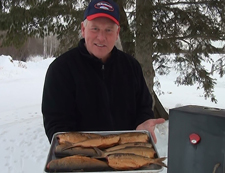
Watch Jeff walk through the whole process on video. Smoking Tulibees January 2011. |
5 Lbs Canning/Pickling Salt
2 Lbs Brown Sugar
2 TBSP Onion Powder
1 TBSP Garlic Powder
1 TBSP Mace
2 TBSP Oregeno
This recipe makes several batches of smoked fish and can be used for other meat too. Mix thoroughly, store in well sealed zip-lock bags.
For me, 1Gallon size freezer bags with 1-1/2 cups of powder in each is perfect. |
In large plastic bag, add about 1 cup of dry mixture and shake moistened fish in powder until coated liberally. Add small portions of dry brine as needed to avoid mixture becoming wet or "slushy". Coating should be uniform and heavy. For larger, whole fish, add powder to inside of body cavity.
Place fish in suitable plastic, crock or glass container. While curing, store in refrigerator. Curing time depends on personal taste, 6 to 12 hours depending on size of fish and salt taste desired. |
Use a clean crock, glass container or plastic pail. Do not use metal container. Mix 1-1/2 cups of powder in about 8 cups of water, stir until mixed thoroughly.
Check for correct mixture by dropping in a peeled potato or fresh, un-cooked egg. The egg or potato should float easily. If either will not float, add small amounts of powder until they do.
Place fish in liquid and use a glass plate to keep pieces completely submerged. Soak 8 to 12 hours. Keep chilled, stir occasionally. |
For either method, remove cured pieces of fish from brine, rinse in cold water and place on paper towel covered cookie sheet(s). Keep fish refridgerated and let dry until outer skin feels dry to the touch. Once ready, smoke fish for about 2.5 hours at 220 to 240 degrees.
|